About a life devoted to the love for Folklore, Mythology, Legends and.....Art
Showing posts with label Illustrations: myths and legends. Show all posts

Sunday, November 21, 2010

The Sketchbook Project!


I finally have some time to tell you all about my latest project! It is a small project which I only did for fun's sake and also because I wanted to get my mind off of things during these busy months.
As usual I focused on the folklore theme, in this case Dutch folklore, but let me first tell you a bit about the project itself.


The Sketchbook Project:

The Sketchbook Project, an initiative of Art House, is a collaboration of artists who submit their sketchbook in order to create the largest traveling sketchbook library in the world. Thousands of sketchbooks will be exhibited at galleries and museums as they make their way on tour across the USA. After the tour, all sketchbooks will enter into the permanent collections of the Brooklyn Art Library, where they will be bar coded and available for the public to view.
At the moment 28594 artists from 94 countries around the world are participating and one of these artist is me :-)
To find out more about the project and the tour dates please check out their website: LINK


About my Sketchbook:

It will probably not surprise you that I decided to work with the folklore theme for my own Sketchbook. I thus created a character: Mister Oswald who is a professional folklorist and story-collector. For his work he travels through Holland in order to collect as many folktales as possible. These tales he writes down in his journal, accompanied by drawings he makes and other things he finds on his way.
My sketchbook: Mister Oswald's journal, will thus be a collections of tales and drawings, old and new, put together in one small book. Which I hope many people will enjoy to read and view !

I will upload scans of the journal/sketchbook pages on my Deviant Art account as well as my profile on Art House.
Those of you who are not able to visit one of the exhibitions can thus still see the sketchbook and read the folktales of my country.

You can view the entire contents of the sketchbook here: LINK

Enjoy!

Sunday, October 10, 2010

Witte Wieven - A Dutch Folktale

(Please, click picture for bigger and better view)

'Why all these Dutch folktales all of the sudden? ' some of you might be thinking. Well, I have started a new folklore related project a few weeks ago about which I will tell you all later this week.
But first I would like to share with you my latest drawing, which is also part of the project, named: "Witte Wieven". These two small words have two different meanings. Witte can mean white or (in dialect) wise and wieven means women. Thus it can refer to white women or wise women. In this case both interpetations would actually be correct.

These Witte Wieven are always described by the people as white, ghostly, witch-like figures, often brought in connection with mist. They haunt the old burial-mounds, which can still be found in the Netherlands, dating back to the Iron Age. It is not a coincidence that these ghostly women are haunting these burial-mounds because the Witte Wieven are infact the vestiges of the old Germanic priestesses worshipped by the people. The church obviously disapproved with this sort of worship like they cursed the old burial mounds, being graveyards of heathens. And soon the two: Germanic priestesses and the burial-mounds, became connected.

The people for a long time strongly believed in the powers of the Witte Wieven. They often left food for them in order to recieve their blessings. Their favorite food was balkenhaze, which is the name for roast cat and pancakes. It was believed that if one should refuse to offer the Witte Wieven food they would take revenge. They would kill cattle by sticking long needles into the animal bodies and burn down sheds and if you were really unlucky they would kidnap you. They were especially known for kidnapping young mothers, because they needed them for feeding their young dogs. It was said that the Witte Wieven sometimes had such long breasts, because of the feeding, they could throw them over their shoulders. Hence the reason why they preferred other women to do the job, I guess. Once these women were captured they had to stay with them for 7 years, after which they were released.

The Witte Wieven were also great sorceresses; who could turn wood into gold and such. This is why the people were making offerings, in hope they would share these gifts with them.

There must be hundreds of folktales related to the Witte Wieven: stories about revenge they took on young rude boys, women they kidnapped and about women who knew how to escape. Tales about farmers who owe their riches to them and farmers who lost it all because they broke with the tradition of food-offerings.

Nowadays, the people in the eastern parts of the Netherlands no longer believe in these matters, but the tales they have survived. But if you are lucky to meet one of the old farmers they will assure you all of it is true and they still look at the burial mounds with a suspicious eye. Of course, they know better....

Sunday, September 12, 2010

De Bullebak - A Dutch Folktale


I know I said last time I would draw one of the legends I collected during my trip in France, but for some reason I just could not get to it yet.

However an image of another legend, I grew up with as a kid, haunted me for days, till I at last put it down on paper. It is the story of the Bullebak. A Dutch water spirit used by parents to frighten children and keep them away from the water. Something of which we have a lot here.

Now the word bullebak is hard to translate literally, but in means as much as bully and refers to someone or something which harasses another person because he likes to do so. This word is used in general but also refers to a terrifying water spirit. Its description is quite diverse and parents have become very creative with it as well through time.

One of these descriptions is that of a creature living in the water with the head of a bull. Others say that the creature has never been seen but has the habit of luring children with shiny little stars to the waterside and then grab them. Many of these descriptions also include a big fish.

I however grew up with the story that the Bullebak was a gigantic bullfrog. When it caught you it would drown you and eat you up whole. I can't even recall how many times my grandmother warned me for the Bullebak, but it must have been often. Even now at the age of 25 I still can recall the images I had in my mind as a kid when listening to these stories.

Well, that is the story of the Bullebak I grew up with! (And for those who are interested, prints will soon be for sale at my shop.)

Monday, August 2, 2010

The Werewolf Trial

(Please, click picture for bigger and better view)

Last week I have made another drawing for my new werewolves series, it is called the Werewolf Trial. The drawing isn't based upon one story but more or less incorporates a whole series of stories I have read over time about werewolf trials into one. I myself am not at all an expert on the history of these trials, as history is not as much my topic as folklore is, but it has always surprised me how few people know about them. These trials are often standing in the shadow of the well-known witch trials which took place about the same time. And I can't help but to find this very odd because, in France alone, around 30,000 people were executed between 1520 and 1630 suspected of being a werewolf.

Apart from people being executed, commonn wolves which were seen near the villages got caught by the people and killed on the same accusations. But it was only on rare occassions that an animal was actually put on trial and had to show up in court. But it did happen every once in a while.

Though less commonn, I found the subject of the wolf being the one executed a lot more interesting for my drawing, and that is why a wolf instead of a man is being burned at the stake. However the soul which leaves the body is that of a man and hereby reveals it's true identity to the crowd gathered around the stake. This actually refers to a well known folk belief concerning werewolves in which it is said that by injuring the werewolf the spell would break and it had to transform into its human shape again. In other stories the injury only leads to the werewolf running away. The wound, however, would stay on its skin, also when it finally turned into its human form again. When the person could not hide its wound this sooner or later lead to recognition as well.

How one could injure a werewolf succesfully differs per country, the silver bullet is one of them. In the Netherlands this had to be 'erfzilver': silver inheritad by some deseased family member. In other coutries it had to be silver from the church, especially silver dedicated to saint Hubert which was believed to be very efficious. In Normandy, France, it was believed one had to stab the werewolf three times with a knife in its forehead though others said that three drops of blood drawn by a needle would be enough. Fire was also considered by many as a most potent weapon to battle werewolfs.
This last belief is the one depicted in my drawing where fire forces the soul to appear in its true form.

For those of you who are disgusted by all these violent measures, which I completly understand, it might be a nice thing to know that there were also less shocking ways to make a werewolf appear in its human form. One of these examples was to call its human name three times. This of course was only possible if you already knew the identity of the werewolf. Another method was to throw a piece of clothing to the werewolf. It would then be so occupied by tearing the piece apart that there would be enough time to escape. The following day, one could easily recognize the werewolf, because once changed into its human form again one could still see small pieces of clothing between his or her teeth.

Next time I will share with you all a drawing based upon a werewolf tale I came across in Southern France! One of which I don't think many of you have heard of....

Sunday, July 18, 2010

Back from France and something about werewolves...

Yes, I have returned safely from my trip to France! I have had such wonderful time and you wouldn't believe how many legends I have found during this trip. By coincidence we, me and my best friend, came in contact with a writer who knows all about the legends and mysteries of that area and for four days he drove us around -ours managed to break down- and showed us many places connected with these tales. Through the years he has written three books on the subject and of course I wanted to have these books!

Before I left I told you all I planned to keep a diary, make illustrations and of course tell you all about these legends. Because of the many, many legends I found I haven't been able to finish the drawings before my return. As it is simply impossible to show you all my work at once I will post a new drawing and legend once a week. Eventually I will combine all these drawings and stories and make one webpage for it so you can read them all if you like.

Another thing which has kept me busy lately are werewolves......

(please visit this link for a better view!)

Just before I left I made a drawing called, the Werewolf-Apocalypse, or something like that. To tell you the truth I haven't yet figured out how I would entitle the drawing. But a title is always better then no title I guess. The drawing is based on Dutch folk believes concerning werewolves. In Holland, unlike some other countries, the werewolf was strictly related to the devil (there were a few exceptions that I know of but this was the general belief amonsgt people). Only by complex rituals, in which the devil usually got invoked, one could gain the capacity of transforming itself into a wolf. About these rituals I will tell you all later when I have finished my second drawing relating to this subject.

Because of its close connection with the devil you can see demons 'leading' the pack of wolves in my drawing. Another Dutch folk belief I read about tells werewolves can't enter buildings, especial churches, which were safe havens. It was said that in Heteren, a small village in the Dutch province of Gelderland, it was quite common that these beasts used to pass the houses at night and could do nothing but stare, with their red fiery eyes, across (what we call in Holland) the "onder-deur" (literally translated 'under door'). This was a specific kind of door often seen at farmhouses which existed out of two separated parts. Often the lower part remained closed while the upper part of the door was left open. I'm not sure if I am being clear but here you can view an example of such door: link

If you were on the road and there wasn't a building near to keep you save you could simply draw a line on the ground with a stick and say : "Als je van God bent, kom dan nader!" translated: 'If your from God, aproach!' In which case the werewolf could not cross the line or would run away out of fear for hearing God's name. This is just one way to keep these creatures away, there are of course many more methods to achieve the same. If these creatures were so easily to scare away, it makes you wonder why people were that afraid..... Maybe it was because they told each other werewolves killed entire floks of cattle and this would of course have been a great loss.

Based on these believes, and some other legends I found about werewolves terrorizing local villages and there people, I made this drawing. I find the whole subject to be most intriguing so I do intend to make more drawings in the near future .

But for now I will have to try and catch up with everything before starting on a 'new project'!
Also some news about the Tell Me A Story Project and the book will follow later this week. No, I haven't forgotten about it :-)

Sunday, April 18, 2010

Tell me a story; Maria Karamot

Here it is; the last drawing I made for the Tell me a story-Project. It feels a little bit strange this project is now comming to an end after all those weeks of hard work and collecting tales.

However, this also means that within two months or so the book will be ready for publishing!
During that time I will still keep all of you updated on the progress and I might be giving away some books once the book is published.....

So stay tuned and I hope you will all enjoy reading the following tale!

(Please, click picture for bigger and better view)

Story Title: Maria Karamot
Submitted by: Russel Quinto
Country: Philippines

Once there lived beside the sea a couple named Juan and Juana. For a long time they were childless. When Juana was at last with child, they were quite happy. But in her pregnancy, Juana would become very restless if she did not have milkfish to eat every day. So one afternoon, when Juan failed to catch any milkfish, he became very sad. Suddenly, Juan heard his name called. He was greatly surprised when he looked down and saw a shiny milkfish wearing a crown. The milkfish identified himself as the King of Fishes and he asked Juan: "Why do you fish only for milkfish?" Juan told him the reason, and his sorrow at the moment.

The King of Fishes pitied Juan and promised "I’ll give you plenty of milkfish everyday. But in return, you are to deliver your coming child to me when it turns seven years old." Because it was already getting dark and since milkfish was becoming scarce that season, Juan finally agreed. The King of Fishes was true to his word. Even after Juana had given birth, Juan continued to bring home milkfish from the sea. Their child was a lovely girl with very black hair. They loved her and were very happy with her. They called her Maria. When Maria turned seven, Juan went to see the King of Fishes and begged him: "Have pity on us. Can’t you possibly release me from my promise? We love Maria very much, and we can’t bear to part with her." But the King of Fishes was firm, saying "A promise is a promise." With a heavy heart, Juan went home. Since that day, the couple and Maria never went near the sea.

But one day, while Juan was on the farm and Juana was doing the laundry in the river, there came a big wonderful boat. The people immediately flocked to the shore to see it. Maria was alone at the time and was looking out the window. She became curious and joined the rest on the shore. While she was watching the wonderful boat, a big wave rushed up and dragged her to the sea. Immediately, the neighbors told her parents of the incident. Juan and Juana ran to the shore but they were too late. Maria was gone! Every evening after that, the couple would stand by the shore and stare at the deep. They kept hoping that Maria would return. Years passed and still they failed to see her. But one moonlight night, there appeared before the old couple a lovely creature. She had very long black hair, but — while half of her body was that of a beautiful girl, the other half was that of a milkfish. Then they knew that it was Maria, now a mermaid.

Maria grew up to be a very beautiful woman with long black hair and expressive set of brown eyes. She cannot remember that she once was human for the King of Fishes took away all trace of her memory when she was taken suddenly many years ago. She grew up with other mermaids of her kind at the bottom of the sea who took care of raising her as their own. But every full moon she would rise up to the surface to admire the beauty of the earth which she found herself unexplainably drawn into.

The King of Fishes noticed Maria's restlessness and tried to cheer her up by promising to grant whatever wish she wanted. "I would like to be able to walk like the humans," she asked in earnest. The King of Fishes replied, "I will grant your request to walk like the humans but only while the moon is full." And so it was that Maria was able to walk on the "pampang" during full moon. It was during one of her walks that she stumbled upon a young man who was walking alone in the night. She was not aware of her nakedness and the man was surprised to see her. He didn't seem to mind her nakedness too but instead asked her who she was and where she was going. That was the start of the friendship between Maria and her male acquaintance whose name she later discovered as Ramon. Unbeknownst to her, he was in fact, a siokoy - a male sea creature sent by the King of Fishes.

Their friendship quickly blossomed into a romantic relationship and not long afterward Maria conceived and gave birth to a healthy baby boy who looked very much like his father. They were very happy and would often swim together especially on bright moonlit nights. Maria forgot her sadness and was completely happy. One night when the full moon was incredibly bright yellow in color, Maria was aghast to see a crowd of fishermen gathering around a huge fishnet where to their surprise they have caught a most amazing creature - a boy covered with fish scales and terribly distraught. Maria hid herself behind the bushes where she saw the fishermen lift their prize catch to the shore. To her great shock and horror, they started to hit the creature with their paddles and sticks until the poor thing stopped moving. Maria saw everything but cannot believe what happened. They killed her little boy.

Sometime at midnight, the people of the small fishing village were awakened by an eerie wailing coming from out of the sea. It was so haunting and spine-tingling that nary a soul was able to get to sleep for the rest of the night. The following morning, the villagers were shocked to discover the lifeless body of one of the fishermen along the seashore. His body bore scratch marks all over. He apparently drowned the night before while relieving himself after a drinking session with his friends.

Thus the legend began of Maria Karamot as she was henceforth known because her victims bore scratch marks in their bodies. Every now and then, the sea will claim its next drowning victim for no logical explanation. Sometimes, excursionists and out-of-town vacationers will for no reason become the next unwitting victim of the pristine and inviting sea that carries with it the sorrows and pains of a grieving mother still trying to understand why her child was taken away from her.


Thursday, April 8, 2010

Tell me a story; El Silbón (The Whistler)

You'd better not read the following story if you are alone at night. For the tale which I am about to share with you now is most certainly one of the scariest folktales I have ever read.
For those of you who would like to listen to the whistling sound please follow this link:

link
(But do read the tale first!)

Note: If you are not familiar with the project, please check out my previous blogpost here.


(Please, click picture for bigger and better view)

Story Title: El Silbón (The Whistler)
Submitted by: Jose
Country: Venezuela

This is story of The Whistler, perhaps the most famous and feared ghost in Venezuelan folklore. As with many folk tales, this one is preeminent in rural areas, specifically in the vast plains of the midwest of Venezuela.

There once was a man who killed his father. There are at least two main versions of how this came to happen. One says that the man had a beautiful wife and one day he came home to find his father behaving abusively towards her. The man exploded in rage and killed his father. Another version has it that the man was very spoiled, and one day he started craving deer heart and liver for supper. His father went out hunting so that his son could have his meal as requested, but he had no luck in finding deer. As it was becoming late and the father had not returned home, the son decided to go fetch him over at the hunting grounds. Once there, seeing his father as-of-yet empty handed, he burst into anger and killed him. Then he extracted the heart and liver from him, and took them home to his mother so she could prepare them for his dinner. The meat was too hard and wouldn't soften no matter how long she cooked it, so she started to suspect that these were in fact her husband's innards, and so cursed her own son for killing his father.


Independently of which "murder version" is told, the story always becomes consistent when it arrives to the point of punishment. The man's brother, hearing the news of his father being murdered by his own kin, set out to hunt and find the man, and when he did, he punished him with a whip until all his body was covered in wounds. Then, he sprayed burning flakes of red hot peppers onto his open wounds, and lastly, he unleashed a great, vicious dog and ordered it to go after the man and hunt him down.


Now the man is forever doomed to wander the vast rural plains of the midwest, carrying on his back a large sack full of bones - some say his father's bones; some say they're the bones of his victims. He prefers to haunt cruel, un loyal men who cheat on their wives or treat them badly, but it has been said that he also attacks drunks when they're fast asleep.


Sometimes The Whistler ventures into homes at night, and lays open his sack over the floor and starts counting the bones it carries. it is said that if nobody hears him counting, or if nobody notices his presence, then the next day one of the inhabitants of the house will die.


The image of The Whistler is a terrifying one. He is said to be disproportionately skinny and tall, about 6 meters in height, towering over the tree tops with his sack of bones slung over his back. The vicious dog still chases him, and bites his heels over and over again, until the end of time. He wears a tattered white suit and a wide-brimmed hat of the kind used in the Venezuelan plains (wider than an American cowboy hat, but not as wide as a Mexican sombrero). Very few have seen him and lived to tell about it.


In fact, the most distinct sign of the presence of The Whistler is... his eerie whistling. He whistles while we haunts the plains at night, a simple yet bone-chilling sound consisting of the seven notes, in order: do, re, mi, fa, so, la, ti... whistled rather slowly and extending a bit each note at the end. It is said that when the whistling is heard to be close, The Whistler is in fact far away, and there is nothing to fear. But if the whistling seems to come from afar, then it means that The Whistler is near. Some people barely notice this seemingly long-distant whistling, and when they do, it is usually too late.


However, as with many ghosts and creatures of this kind, there are ways of being saved from their evil intentions. if someone happens to encounter The Whistler, it might be a good idea to remember him what happened: his horrid crime, his punishment, his eternal curse. Other people prefer to have a whip around the house, or carry some hot peppers, or even have a dog around, as it is said that these are the three things The Whistler fears the most.


Tell me a story; The origin of stained glass

A most curious story was send to me some time ago. When I first read it I wasn't sure if the story was suitable for the book as it was very modern and in a way it was more a fairytale then a folk tale. For some time I laid the story a side, but for some reason my attention was constantly drawn to it. Yes, it was a little bit too modern and yes, it wasn't a 'real' folk tale, but it was so beautiful and unique but above all it was something I never heard before.

So, I contacted Nicholas and asked him how he had heard of the tale. As it turned out his girlfriends father is a marvelous storyteller and the tale about the origin of stained-glass was just one of the many tales he had told his daughter. He also told her that when she was born she was so small she had been the size of a mustard jar.
As far as Nicholas knew, the tale has never been put on paper before and I do not doubt his words for I am certain of it that I would have heard of it if so.

This tale may not have a very long tradition but perhaps now it will be passed on and who knows, it might become a real folk tale someday.....


(Please, click picture for bigger and better view)

Story Title: The origin of stained glass
Submitted by: Nicholas Corcorran
Country: Main (USA)

Once, there was a compact little princess with golden curls. Hair softer than silk that shone brighter in the sun than any of the diamonds or golden necklaces sold in the goldsmith’s shop. The people of the castle and surrounding town all loved this princess because despite her beauty she was not vain. She never spent a single dollar on herself. Of course she was so beautiful she needed no jewelry to boost her image. She spent the money improving the town and investing in its development. She paid for the roads to be paved and bridges to be built. To protect the townspeople she built a tall and thick wall. It was taller and wider than any wall. And the people of the town were happy because they were safe.

This princess threw a giant Feast at the change of each season to celebrate all that was healthy and vibrant in music and food and art and drink. And these were no paltry fairs or fly by night parties. They were well organized and extravagant. The princess had musicians and chefs and artists from all over the world visit the town to perform, and share their delicious creations and put on display the beauty of their works.

One particular year, at the Feast For Spring, a young band of street gypsies appeared in the court to perform for the princess. These gypsies were dressed in vibrant colors of cloth, and both the men and women in the troupe wore make up on their faces. The leader of the gypsies was a smooth-tongued man, vocalist, dabbler in magic, and an accomplished poet. He could recite in full, the great tales from the Far East, The Amazon, and The Outback in their native languages. The gypsies performed amazing feats of balance, played tricks with fire. They took over the evening and after several encores, their performance lasted until morning. Then the townspeople stumbled home to their beds, and the princess took this well spoken gypsy up to her room to hear more of his stories.

Later, while he was sleeping, she discovered a small folio. On the parchment were written all the words he had spoken to her. Words which he claimed to be professions of love, but which she now realized were merely lies told to seduce her. Quickly, before he woke and could again beginning spinning his love words and tales of lies, she ran high up to the vault tower. It was the safest place in all of the kingdom - a tower so tall its views looked out upon the surface of the clouds, too tall to ever climb.

In the vault tower, she opened a golden chest, and placed her heart inside of it, so that no one, not even the gypsy could ever again try to steal it from her. Upon returning to her chamber she immediately had her guards banish the gypsy and his troupe from the castle, hoping it was the last time she would ever see or hear from him again. Just in case, she had the walls built higher and thicker to safeguard her heart and prevent him from seducing any of the other eager hearts in her kingdom.

At first the gypsy beat upon the giant oak doors to the castle, first with his fist and then with his open palm, hoping that the loud smacks would resonate and carry up over the walls. He beat out different rhythms he had learned from deep in the bush of Africa, ones that mimicked the language spoken between two lovers… heartbeats.

He gathered his fellow gypsies and called upon others. He acquired orchestras and musicians. Every man, woman, and child he’d ever known to strike a chord he asked for help. Day and night he sent songs up into the air, pleading for the princess to just let him explain. But she heard none of it.

He tried throwing up rope and building a ladder but the walls proved too tall.

One night, as he rested beneath the stars he looked up into the skies asking the gods for a sign. It was then that The Great Bear shone brightly in the sky. Many people today refer to this constellation as the big dipper, but in ancient times it was the inspiration for an invention that went on to become revolutionary. Not coincidentally it would go on to be used in war, but in this case it was built for love, which many great philosophers have considered to be the same thing.

The gypsy sent for great minds, mechanics and engineers. With the help of a very old man from what is present day China, the world’s first catapult was constructed.

(For reasons that have never been properly explained, the catapult was never tested. Why these great engineers would never have tested the invention before allowing the gypsy to use it has befuddled historians for thousands of years. Perhaps the gypsy just couldn’t stand to wait any longer.)

So, the moment the construction was finished, the gypsy, holding the folio which had began the whole mess in the first place, climbed inside the cup of the catapult, and told his men to aim for the tower. He knew that a great haystack sat at the base of the tower, which was near the royal stables. He was convinced destiny would provide him a safe landing.

The engineers ratcheted back the catapult, and with no one wishing to pull the lever, the gypsy picked up a stone and threw it at the lever, thus literally launching himself into history.

It should come as no shock, that an untested catapult will provide unexpected results. The catapult was too powerful. Some say this was caused because his love for the princess was too great. It shot him high into the air. Higher than the birds fly and up among the stars, leaving what is now known as the atmosphere. Upon his decent back to earth, he came down as a flaming comet crashing directly on top of the vault tower.

(One other piece of information that has been lost in the centuries of history is why the ceiling of the vault tower was made of glass. Many think the princess would climb up the tower at night in order to feel closer to the stars. In fact many people believe she was a fallen star and this was where she actually slept because sleeping that high helped her feel less homesick. Nevertheless, the ceiling was made of a thick glass, which had been crafted to be unbreakable of course, for it was a vault tower.)

The princess raced up to the vault tower along with her most trusted guards. What she saw gave her a great shock and caused her a shortness of breath. The dye from his clothes and the blood from his body had soaked into the glass ceiling. Which is where stained glass comes from.

The guards removed the body from the ceiling very carefully and when they set him upon the ground the princess noticed a giant hole in his chest. At first she took this as a sign that her suspicions were confirmed. That the man in fact had no heart. But another guard, concluding that none of the other valuables in the tower had been disturbed told the princess she must take a look at something.

Sitting inside of the golden chest, right where the princess’ heart was kept, was the folio which had started this whole mess. Each page was stained the deepest colors of crimson. When the gypsy landed he had held out the folio to break his fall. The impact of the fall had been so great that his aching heart had exploded out of his chest and been pressed into the pages of the book.

The princess flipped through the book until she reached the last page. Which was left blank. Using white ink, she wrote these words:

I have been waiting my entire life to speak these words.
I have traveled this far
to find your heart.
Spent all of my days to know your face.
I was born to love you,
and that is what this book was intended to prove.
So that whenever you look upon these pages you can see my heart.

For it was intention forever and always to give it to you.

Sunday, March 21, 2010

Tell me a story; Die Sechs Steine

Finally I have some time to update my blog! Due to some problems I had with mail-deliveries (which caused an email explosion from "unhappy"customers) and some technical problems with my computer I just did not have any time to write new posts for quite some time.

But enough about that! Let's continue with the Tell me a story project, which is slowly coming to its final stages. Yes, there are only a few more stories to go before the book will be put together and published.

So, enjoy reading the following tale!


(Please, click picture for bigger and better view)

Story Title: Die Sechs Steine (The Six Stones)
Submitted by: Julia Hecker
Country: Germany

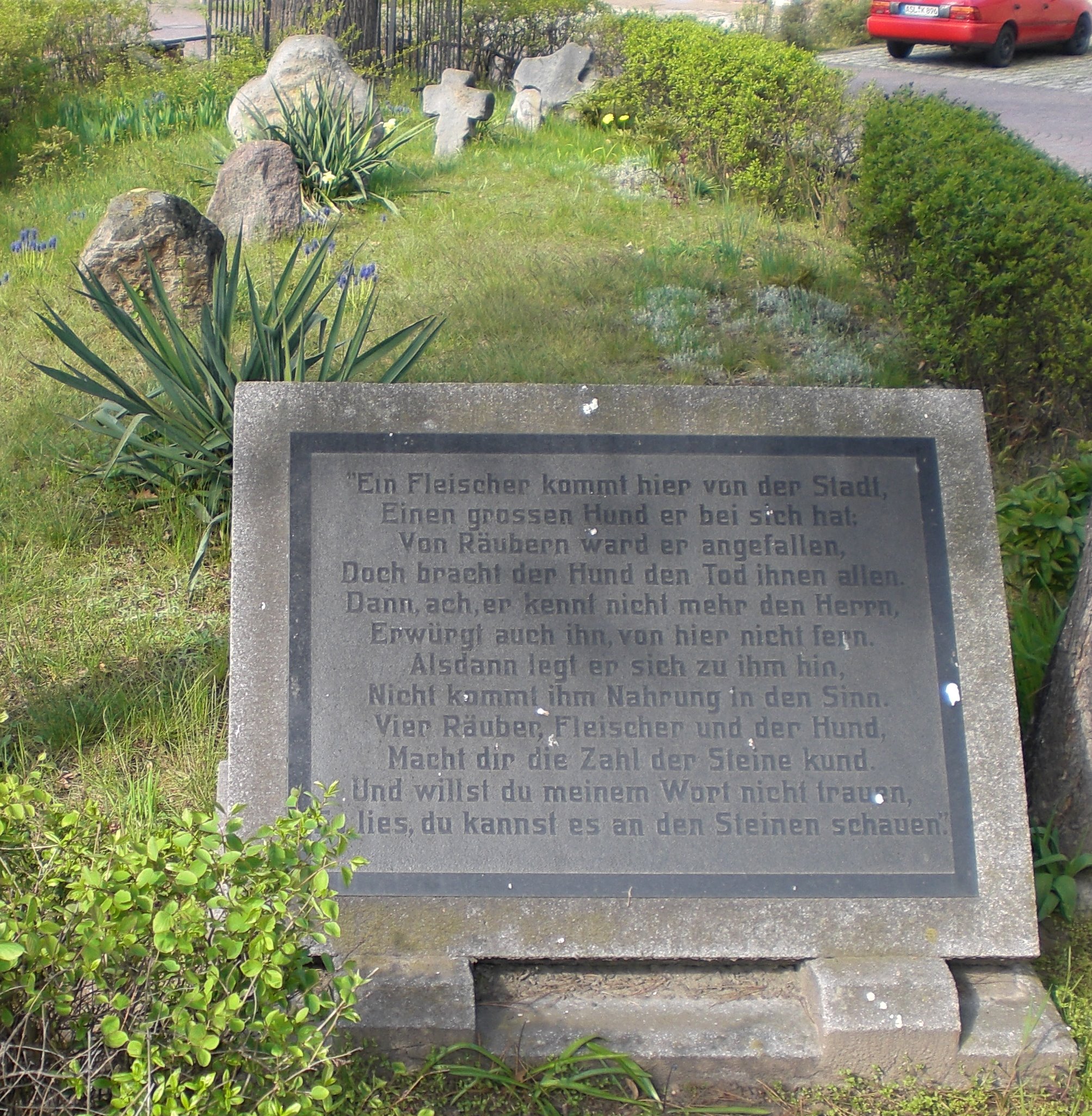
'The Six Stones' are placed in my hometown Ilberstedt. They are the remains of medieval stone crosses. Nobody can tell why they are there. Maybe they are the remains of a cemetery. The oldest cross is from the 13th century. At the cross is an inscription saying: Jacobi Albrecht Weller Famulus 1363.

In front of these Six Stones is a huge stone tablet. There is a rhyme on it that describes the legend. The stone crosses are supposed to represent four bandits, one butcher and his dog. The bandits attacked the butcher at this place and the dog killed the bandits. By mistake the dog killed his owner the butcher too. The sorrow and sadness, resulting from killing the butcher incidentally killed the dog a few days later.


This is the rhyme:


'Ein Fleischer kommt hier von der Stadt,
einen grossen Hund er bei sich hat.
Von Räubern ward er angefallen,
doch bracht der Hund den Tod Ihnen allen.
Dann ach, er kennt nicht mehr den Herrn
Erwürgt auch ihn von hier nicht fern.
Alsdann legt er sich zu ihm hin,
Nicht kommt ihm Nahrung in den Sinn.
Vier Räuber, Fleischer und der Hund,
macht dir die Zahl der Steine kund
und will du meinem Wort nicht trauen

So lies, du kannst es an den Steinen schauen.'

(translation)

'A butcher came to here from town,
a big dog he had at his side.

By robbers he was attacked,
but it was the dog who brought death to all.
Alas, he did not recognize his master

and kills him as well, not far from here.

Then he lies himself before him,

A craving for food never again on his mind

Four robbers, a butcher and his hound,

judge yourself from the number of headstones

And if you will not trust my word,

read the inscription and you will know.'

A picture of the six stones can be found here.


Friday, March 5, 2010

Tell me a story; The Kelpie's Wife

There are some tales of which you have heard many versions, so many you think you must have heard them all. This was my first thought when I received the tale about the Kelpie's Wife. But I was wrong. Again it was a tale I did not know and one which caught me by surprise. It sure makes you wonder how many tales about the Kelpie are out there. Probably hundreds and even then they can still surprise you and tell you some new things you have never heard before......

For those of you who are not familiar with the 'Kelpie-Myth': "The kelpie is a supernatural water horse from Celtic folklore that is believed to haunt the rivers and lochs of Scotland and Ireland. (WikiQuote)".

NOTE: would you also like to see your story get illustrated? please check out my previous blog post here and read the guidelines.

(Those who still wish to submit their story, please be quick because the final deadline is set on March 14th, 2010.)


(Please, click picture for bigger and better view)


Story Title: The Kelpie's Wife
Submitted by: Anonymous
Country: Scotland

There once was a Kelpie's wife, who lived beneath the loch with her baby son, whom she loved dearly. The Kelpie's wife loved her husband but she missed the warmth of the sun and her family, for the Kelpie had stolen (this is the custom of Kelpies who steal their wives) her away from them without so much as a farewell.


One day, when her husband was out hunting victims, the cold and the darkness became unbearable and she fled to the surface, leaving behind her baby son, for she knew the Kelpie loved his son and would care for him. Once at the surface she basked in the warmth of the sun and soon made her way to her parents cottage. Her family were overjoyed to see her, for they thought she had died and so they held a great Celidh.


The Celidh dragged on into the night and the Kelpie's wife soon forgot her husband and child with the joy of being reunited with her family. During the night there came a great storm and suddenly, from outside the cottage, they could hear the champing of a horse's hooves.


Her husband had found his wife gone and was furious, for he loved her so greatly that he viewed her escape as the ultimate crime. Taking the form of a black stallion he banged on the cottage door but he could not enter, for he had not been given permission to enter and cross the threshold. He called for her in rageful screams. The Kelpie's wife was frightened and also sad for she loved her husband but wished to stay with her family. Eventually, during the night, they heard a great 'thud' as something hit the door. After this, there was silence.


In the morning when the Kelpie had returned to the loch, they found lying on the ground, the decapitated head of the Kelpie's son. In revenge for his wife's betrayal he had slain his only son. This was the price to pay for breaking a Kelpie's heart. The Kelpie's wife lived contently and was never again bothered by the Kelpie, who had learnt his lesson of love.

Tell me a story; The haunted swamp

How I enjoyed illustrating the following tale! In a way the tale does not make sense at all, maybe you might even call it a little crazy. Never have I heard of a swamp where this many magical creatures and monsters live, but Carina could tell of one such and it was just around the corner of her father's house!

NOTE: would you also like to see your story get illustrated? please check out my previous blog post here and read the guidelines.

(Those who still wish to submit their story, please be quick because the final deadline is set on March 14th, 2010.)


(Please, click picture for bigger and better view)

Story Title: The haunted swamp
Submitted by: Carina
Country: Denmark

Where my father lives, there's a swamp, and my mother once told me this tale:


When there is fog in the swamp, the bog woman is brewing her ale, and the elves are dancing. Any human who passes by the elves, will be offered some of their wine and asked to dance with them. If he accepts, a beautiful elven woman will dance with him. When he puts his arm around the elf's back, he will notice her back is hollow, but by that time, it'll be too late for him to run. The elves will kidnap him, and bring him to their underground city, where they will keep him as a slave until the day he dies. No-one has ever escaped the hands of the elves.


Apart from the elves, there is also the Nixe, who lives in the lake and lures you to him with his beautiful Violin music. When he catches you he brings you to his underwater-house and eats you. There are the trolls who turn to stone should they be hit by sunlight and the wights who'll keep you as a pet. And every time she told me the story she would always, when the story ended, tell me this: "Don't
ever go into the swamp alone, and don't even LOOK over there when its foggy, so they wont take you away." Thus I was scared to death by the swamp when I was younger.

Thursday, February 25, 2010

Tell me a story; El perro negro de El Escorial

The following story tells us about an extraordinairy happening at The Royal Monastery of San Lorenzo del Escorial in Madrid. What makes this tale so special is that it has its roots not only in folklore but also, for the main part, in history. The lady, who wishes to remain anonymous on my blog, came in contact with this tale first at the age of 9. Because her godfather was one of the historians working at the Royal Monastery, she had the chance to read many of the historical records.Thus this tale has become an interesting composition of facts and folklore, which I am sure you will very much enjoy.

NOTE: would you also like to see your story get illustrated? please check out my previous blog post here and read the guidelines.

+ CURRENTLY I AM HOLDING A GIVEAWAY CONTEST, PLEASE VISIT MY PREVIOUS BLOGPOST HERE, IF YOU WISH TO PARTICIPATE!

(Please, click picture for bigger and better view)

Story Title: El perro negro de El Escorial
Submitted by: RdT Studio
Country:
Madrid, Spain

Special places always hold many stories. That is why special places are always misunderstood. But extraordinary things happen at those places, and that is why they have many legends and unusual records. I like to talk about those, so be my guests for this tale.

The Royal Monastery of San Lorenzo del Escorial, in Madrid’s mountain range, is a very special place. The Good King decided to build it to thank God for a victory in battle and enigmatic things happened from the very beginning.

The chroniclers say that when the architects were wandering through the mountains trying to find the most suitable place for the building a terrible storm started. Instead of taking shelter, the architects decided to go on with their duty. Then, a ray struck the ground just in front of them, and that is how the location of the monastery was decided.

Many stories are told about this amazing place; a curious one is that of it being a Hell-Gate. This belief started when the Monastery was in early construction. The first thing to be built was the church and the convent, since the monks of the order of Hieronymus took residence there from the very beginning. One day, a sudden stormcloud came down from the mountain hiding the sun; a thunder deafened the valley and a ray struck the building, into the sacristy, causing a big fire that lasted for several days. After the thunder, the cloud vanished and the sun came out again. Some people said then that the Devil had visited the place that day in complaint for the holy building. This thought was strengthened when some months later, the first monk who attended to suffocate the fire, the clock maker, died of an unknown sickness.

But my favorite story is that which took place just a little after that.

About a month after the fire, the monks began to hear terrifying howls in the night, and the howling happened every night and could be heard from everywhere in the Monastery. As days passed, some of the monks also said that in the moonlight they have seen a huge black dog dragging a thick noisy chain that gave impossible jumps on the scaffoldings. People in the town grew uneasy and began to wonder about the dog, saying things like that it was an adversity omen, the Cerberus set free by the Devil after his failure in destroying the temple by fire, or the Devil himself that, in the shape of a dog, tried to scare away the monks by keeping them from sleeping. The story grew so famous that reached the capital, where opportunistsicpeople took the chance to spread the story the dog was a vengeful spirit send to complain on the taxes imposed to build the Monastery. All this talking worried the King, who decided to investigate the matter by himself.

On the night of June the 21st, the terrible howling of the dog coming from undergrounds of the construction, under the King’s chamber, reached such an intensity that the monks took refuge in the Sacristy to pray. One of them, however, bravely went down and, aided by other three monks, caught the dog by a leather collar it wore. It was a big animal, yet thin, as if it had not eaten properly in a while. It was wearing a collar from which it hanged a thick chain, as if the animal had escaped from his master’s house by breaking it; the collar showed that the animal belonged to a member of the court but not which member, and no one ever claimed for it.

When the dog was shown to the King, to calm his people, he decreed it to be hanged from one of the convent’s windows until it rotted away, so everyone could see that it was nothing but a regular stray dog. This stopped the gossip, and nobody ever heard the dog howling… but, apparently, the King himself.

When the good King was about to die in terrible pain, he asked about the dog to his last adviser. When the man said that the dog had not been seen since it was hanged the King told him: ‘I see it and hear it everywhere, its barking wakes me up in the middle of the night. We must make spells to keep it from returning; it scares me.’

Almost three centuries later, a writer would say, without mentioning his source, that the King also saw the dog several times during his life, when someone close to him was about to die.

Sunday, February 14, 2010

Tell me a story; The Skogsra

The following tale is of the kind I like the most. It is not from a book and neither is it a story one has heard once from a friend of a friend. No, it is a story Brett Williamson heard from his own grandmother and she heard it from her father, who ensured her it was all true. After all he had a scar as proof.....

NOTE: would you also like to see your story get illustrated? please check out my previous blog post here and read the guidelines.


(Please, click picture for bigger and better view)


Story Title: The Skogsra
Submitted by: Brett Williamson
Country: Corona, CA

The Skogsra, or more easily pronounced Sjora, is a Swedish water spirit that lives in the woods and is known to either help men with good hunting or lead them astray. It is always seen in a forest and always by a body of water most usually looking like a beautiful woman brushing her hair and sometimes having a tail.

There was something I was told by my mother's grandmother about a story that she was told by her father.

From the time he was little he went hunting with his father, the boy became an excelent marksman, and by the time he was 16 he had the skills of a veteran-pro twice his age. One day he went out to hunt by himself with his dog Kysa and as the dog went for something to drink, it was a beautiful young woman he saw. All he could do was stare for the longest time until he was noticed so he went over and introduced himself to the young woman, she never gave him her name.

So the days went on and the boy, who was slowly becoming a man, fell in love with this woman. Until one day, as he went into the woods, he saw her with someone else. The man became furious and confronted the woman, then she became furious and suddenly disappeared. On his way home it became extremely dark and he lost his way and his dog, Kysa. Two days past and still he found no way out of the woods, then something caught his eye; 't was the woman he had fought with and thought he loved.

He goes to talk with her and apologizes about his behavior but then he sees a tail out of nowhere. Well actually out of the back of her dress. So he askes her and she, once again, becomes very angry and attackes him. He yells at her and runs off. Three more days went by and still he could not find his way home out of the woods. Finaly home at last, he runs inside and tells his father about what has happened and his father explained him about what he had met. He understood.

Years later he fell in love with a Romanian girl and lived a long and happy life in America. But he could never forget the face of the woman he almost gave his heart to. And of course there was a scar he could not forget.

Sunday, February 7, 2010

Tell me a story; The Iele

The following story was send to me along with some touching words. Iulia told me how much the following myth meant to her as it was one of those tales she was raised with. She also shared her "concerns" as she noticed how the stories of her people are less and less well known among the younger generations.

Unfortunately this is not only true in Romania. It is a shame. But we must recognize our oral heritage is declining, and worst of all we are responsible for it ourselves.

I do not want to sound overly pessimistic but I am often disappointed in the lack of interest people have in their own culture. On the other hand I am also often pleasantly surprised to see how a myth survives in modern times. And this, luckily, happens often as well.

Like Marie, who submitted the story of the Breton Ankou, Iulia did not wanted me to give her credit for the story as she said the story did not belong to her but to her people. It is always very touching to hear these words, because this is the true nature of folk tales. It is not the voice of one person but those of an entire people. And as long I am hearing these words I am not at all that concerned, because I know there are people out there knowing the true meaning of the words.....

NOTE: would you also like to see your story get illustrated? please check out my previous blog post here and read the guidelines.


(Please, click picture for bigger and better view)


Story Title: The Iele
Submitted by: From the Romanian people
Country: Romania

Not so long ago, living anywhere in the countryside, you could often hear words such as “Oh dear, such a pity of this boy! He must have been charmed by the Iele”.
Ielele are often described as very beautiful girls with charming powers, extremely talented dancers (usually in groups of three, seven or twelve), and living in nice and isolated places; small flowering meadows, in the forests or sometimes at abandoned crossroads or homes. The life in the forests gives them all they need; feeding themselves with the fruits and herbs and drinking clear water from the cold mountain springs.


Some say they are protectors of nature and their place of living is a sacred one, others say they are just mischievous spirits, taking revenge on people for having seen them or interrupting their ritual.

One thing is for sure, they do like dancing and singing! The beautiful girls have twinkling bells on their ankles and go dancing in the forests at night, when the moon is high. Their dance is light; some even say they dance in the air, flying. Oh, and when they dance…they do dance charmingly, with yellow flowers in their hair, holding hands in a fast hora (a very fast traditional circle dance from the Carpathian – Balkan region, encountered mostly in Romania and Bulgaria). Many say that where they have danced, next morning, you can see the burned ground and grass in the form of a circle. In this place, there will hardly be any vegetation growing again and if it grows, no animal would want to eat it.


Many legends in many different regions in Romania speak about young boys and men who have been caught spying on them. The Ielele took their revenge by charming, seducing and taking their minds away (making them crazy). If you hear them singing you will turn deaf, and if you answer to them when they call your name, you will lose your voice. This is the punishment a human receives when interfering with the natural course of a sacred ritual performed by the Iele.


There are many folk songs, poems and “zicatori” (popular sayings) about common people’s encounters with these beings, some good, some bad, some as the people’s heart.


(* grammar note: “Iele” – always used in plural. There is no singular term, since they are always seen as a small collectivity. “Ielele” is the articulated form.)

Sunday, January 31, 2010

Tell me a story; La Llorona

A couple of weeks ago I have invited the hosts of Hometown Tales, Gene and Bryan, to submit a story for the Tell me a story-project. For those of you who are not familiar with Hometown tales please check out their website and blog. They have the most wonderful podcast in which they share strange news, history, urban-myths, legends, ghost tales and folklore with their listeners. I am hooked on this podcast for quite some time now and I have always listened to their show with much pleasure. Thus I was thrilled when they told me they wanted to participate in my project!

Here is Bryan's tale. I hope all of you will enjoy it and if you haven't already, check out their podcast. You will love it!

NOTE: would you also like to see your story get illustrated? please check out my previous blog post here and read the guidelines.


(Please, click picture for bigger and better view)


Story Title: The Legend of La Llorona
Submitted by: Bryan (Hometown Tales)
Country: Santa Fe, New Mexico


I was born in Santa Fe, New Mexico. Founded in 1598 it is the oldest continually-inhabited town in the United States. That's a lot of history. That also means a lot of people have been dying here - leaving behind ghosts and ghost stories - for over 400 years.

Growing up in a town where every night feels haunted - where a child believe that looking out of a bedroom window at night means you might see something else staring back at you - makes you afraid of the dark. And no other tale has had a more chilling effect on my friends and I than the Legend of La Llorona.

There seems to be several versions of the tale, even in modern day New Mexico, where the "wailing woman" is said to still haunt the hills around Santa Fe.

There are too many versions to list here, but they all share a common thread: a cautionary tale of consequences to making a bad decision.

One version says that La Lorna was a widow woman of the 18th century, living near the village of Santa Fe. La Lorna was so intent on finding a new husband, that she neglected her children and her family duties, spending most of her time in the saloons and gambling halls of Santa Fe, intent on finding a man to care for her. She didn't seem to care that, lately, Apaches from the nearby the hills, who often raided homesteads, had been seen. It was during one of her night on the prowl for a man that her children were brutally murdered in an Apache raid, drowned and dumped in a nearby irrigation ditch.

Another version of the story has it that La Llorna was a young beautiful girl who fell in love with a bad man. After giving this man two beautiful children, he turns and find another young girl to run off with. Knowing how much her husband loves his children, La Llorona herself drowns her children to spite him.

Either way it happens, the children die and La Llorona drowns herself in despair. The tormented soul of La Lorna now forever walks the river beds - arroyos - of Santa Fe to, wailing in anguish over the loss of her children.

"Mis Ninos! Donde estan mis ninos?" ("My children! Where are my children?")

Alone at night, of course, before you see her, you’ll always hear that terrifying wailing. Is she looking for her children? What we were told was that she would be happy to find simply any child alone in the arroyos. So we almost never walked to dry river beds, especially at night.

Ironically, it was this centuries old tale of death that kept so many children alive. The legend could have began as a very practical method of keeping us kids out of the arroyos. In the rainy month of August, arroyos could fill up in seconds with a flash flood, leaving anyone in them doomed. It's a classic Boogeyman tale: be good or the boogeyman will get you. Instead, we were told stay out of the dry riverbeds during flashflood season of you'll be swept away by the Wailing Woman.

Sunday, January 24, 2010

Tell me a story; The Selkie

The following story was presented to me as a ballad. Although I do not want to fill the entire book with ballads or poems I am glad to make an exception for this one as it is so true to the original story.
This ballad reflects the style of old, a ballad sung at the hearth. And thus this one is more then perfect for a folk-tale book, as you have to keep in mind; these stories were passed on as music and poems as well.

The ballad's writer; Kiera Tauro first heard of this story in the beautiful Irish film; the Secret of Roan Inish. Kiera herself is from Canada but her mother hails from Ireland and as she grew up with many a story from her mother's motherland the story of the Selkie was one to return now and then. Perhaps even more then the other tales this one was often on her mind. "I had wanted to try my hand at writing a version of the myth for ages," Kiera told me "and when I had to write a ballad for a creative writing class at school this was the first thing that came to mind". And thus she transcribed it into this ballad which I hope all of you will enjoy.

NOTE: would you also like to see your story get illustrated? please check out my previous blog post here and read the guidelines.


(Please, click picture for bigger and better view)

Story Title: The Selkie
Submitted by: Kiera Tauro
Country: Canada

Walking on an island, on a day both bright and clear
He spied a creature on the rocks and quickly wandered near.
The seal had not yet seen him and he saw it shed its skin
And like butterflies from the cocoon, a lady stood within.

The skin it lay abandoned like yesterday’s disguise,
And careful not to startle he stood and met her eyes –
As black as the ocean and as wild as the sea,
Full of wonder, like a curious child she gazed back at me.

A whisper brought him closer and a touch to her side
Their voices rose and fell, matching the pounding of the tide.
Conversation faded and love grew in its place,
She said “I must go,” with a smile upon her face.

“I will meet you on the morrow, but to the sea I must go.”
And skin in hand, the lady left for the water down below.
He came back every morning and she left him every night,
But soon he had an idea that would keep her in his sight.

Reluctant to consider it, but more to see her leave
The skin would be stolen, was the plan he would weave.
“For without the skin she could not go back to the sea,
And thus would be content to stay ashore with me.”

And so one day while she slept, her head against his chest
He slipped out from beneath her and stole it from her breast.
Carefully it was hidden and he was back afore she woke,
But soon her eyes had opened and softly she spoke:

“My skin you have stolen, and the sea that was my life,
I am damned to live on land, and this can only lead to strife.”
The days seemed to last forever, and she wandered as if lost,
But she vowed to find her skin, no matter what the cost.

Long she searched to no avail and soon she gave up hope,
For without the comfort of the waves she found she could not cope.
Little more than a shadow she sat above the tide,
Watching the place once called home as quietly she cried.

Her silence did not please him and he loved her less each day,
His beautiful wild selkie girl had begun to fade away.
Not a word was spoken but still she seemed to plead
For the skin long since taken, for his avarice to recede.

And though he loved her less, he refused to let her go,
For she was his and did not belong to the sea down below.
The seasons kept on changing, and all fondness seemed to fade,
When the lady heard a whisper coming from the glade,

The forest spirit had seen her and noticed her distress,
And knew that to make her smile, her skin she must possess.
So he had searched and he had found the skin that she had worn,
And presenting it to her, he saw that she did no longer mourn.

Eyes aglow, a whispered thanks, and quickly she did go,
As she often did in dreams, to the sea down below.
Never thinking to return and never looking back,
She slipped between the waves into water deep and black.

It wasn’t until she was gone that he finally he saw,
As wonderful as it had seemed, his plan possessed a flaw.
He had loved her because she was beautiful and because she was free,
But the only lover that she could know was the loveless sea.


More of Kiera's poems and photographs can be found on Deviant Art.
Also, you can read more about the Selkie here.